
Public API
A small, read-only HTTP API for fetching server status from outside the panel: a status dashboard, an uptime monitor, a Discord bot, a home-automation rule. It is served by the panel itself and returns the same live data the panel’s own pages show (from the in-memory cache), so polling it never touches Docker.
It is off until an admin uses it and admin-gated. Nothing is exposed until a token exists.
Enabling it
Section titled “Enabling it”Settings → Public API → New Key. Give it a name, choose what it can see (all servers, or a specific subset), and optionally an expiry date. The full key (a Bearer token) is shown once, in a dialog; copy it now, because only a short prefix is kept afterwards, for identification in the list.
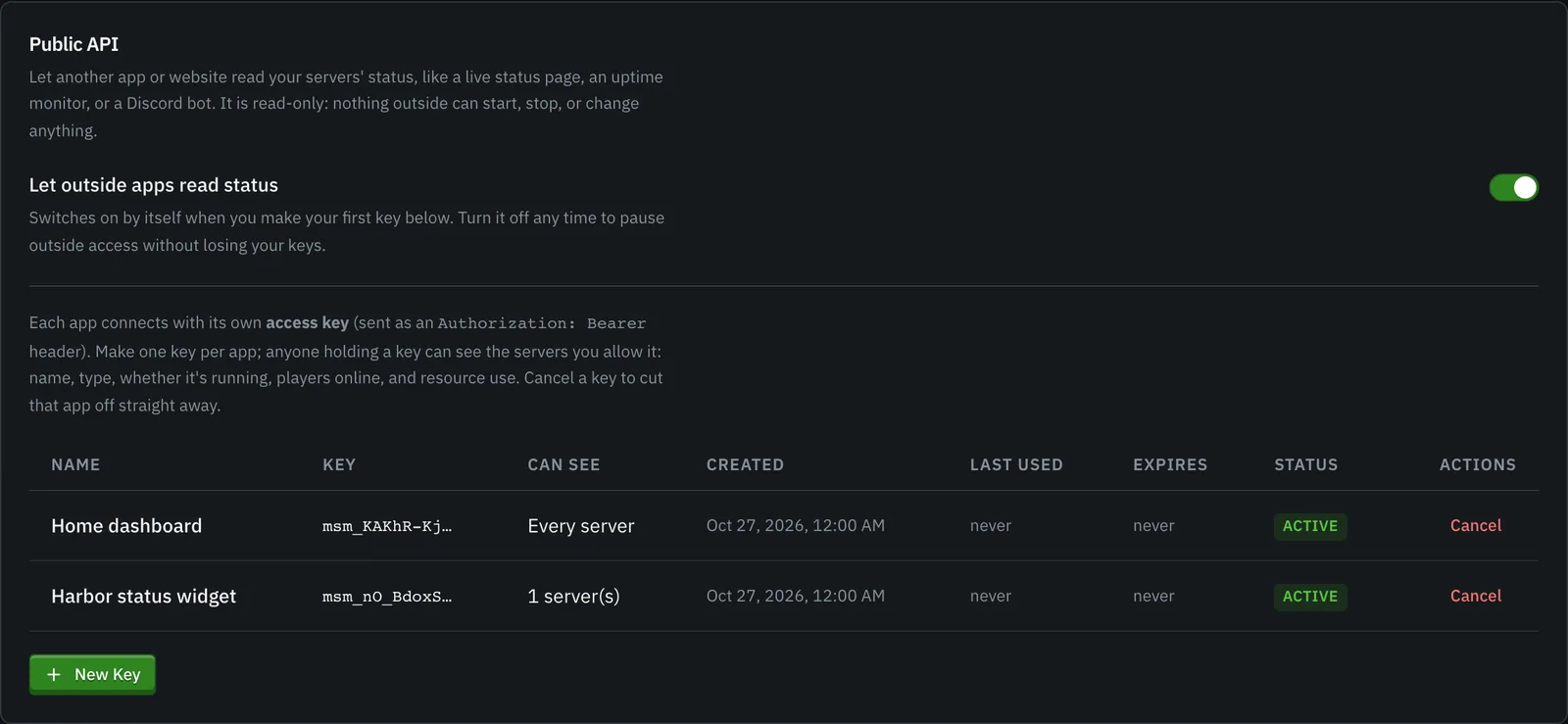
Creating the first key turns the API on automatically (the Let outside apps read status switch is a pause control: turn it off to stop serving without cancelling any keys). Cancel a key from the same table at any time; clients using it lose access immediately.
Tokens are stored as a SHA-256 hash (never in plaintext), survive a panel restart, and outlive the servers they are scoped to (a deleted server simply drops out of that token’s results).
Authenticating
Section titled “Authenticating”Send the token as a Bearer credential:
Authorization: Bearer msm_xxxxxxxxxxxxxxxxxxxxxxxxxxxxxxxxxxxxxxxxxxxThere are no cookies and no CORS: this is for server-to-server and CLI
callers, not browser apps on another origin. If the panel is behind a reverse
proxy, make sure the proxy forwards the Authorization header.
Failures return 401 with { "ok": false, "error": "..." }. Anything other than GET
(or HEAD) returns 405. Unknown paths return 404. When the API is disabled, every route
returns 404.
Rate limit
Section titled “Rate limit”Each token gets its own budget, RATE_LIMIT_PUBLIC_API_PER_MIN (default 120
requests/minute; 0 disables the limiter). Over the limit returns 429. Every request,
before its token is even checked, also counts toward a per-client-IP cap of five times that
number, so probing with missing, malformed, revoked, or expired tokens cannot bypass the budget
by rotating them.
Endpoints
Section titled “Endpoints”GET /api/v1/servers
Section titled “GET /api/v1/servers”Every server the token is scoped to.
{ "ok": true, "total": 1, "online": 1, "servers": [ { "id": "srv_ab12cd34", "name": "SMP", "type": "PAPER", "state": "running", "cpuPct": 18.4, "memoryMb": 2048, "memoryLimitMb": 4096, "uptimeSeconds": 11722, "players": { "online": 3, "max": 20 } } ]}GET /api/v1/servers/:id
Section titled “GET /api/v1/servers/:id”One server, same object under a server key. Returns 404 for an unknown id
and for a server the token is not scoped to (no existence oracle), and 400
for a malformed id.
Response fields
Section titled “Response fields”| Field | Meaning |
|---|---|
total |
How many servers are visible to this token (after its scope filter). |
online |
How many of those are in state: running. |
id |
Stable server id (srv_...). |
name |
Display name. |
type |
itzg server type (PAPER, FABRIC, AUTO_CURSEFORGE, …). |
state |
running, starting, stopped, or crashed: a stable summary of the panel’s internal status. |
cpuPct |
Recent CPU %, or null when the server is not running. |
memoryMb |
Resident memory in MB, or null. |
memoryLimitMb |
Configured container memory limit in MB, or null. |
uptimeSeconds |
Seconds since the container started, or null. |
players |
{ online, max }, or null until the server reports a player list. |
Example
Section titled “Example”curl -s https://panel.example.com/api/v1/servers \ -H "Authorization: Bearer $MSM_TOKEN" | jq